
Extracted and translated from vijñapti to Śrī Haribhakti Vilāsa by Śrī Haridās Śāstri.
A disciplined human life is the sole means to true advancement, in other words, progress, the rise of good fortune, prosperity, increase of auspiciousness, joy, and the attainment of one’s cherished goal. In the absence of discipline, human life becomes utterly inauspicious; so much so that a single undisciplined person becomes not only a burden upon the earth but also a source of distress to all living beings.
Śāstrīya bhakti-dharma (the bhakti-dharma taught by the scriptures) is full of sound guidance; it alone has the singular arrangement for granting fearlessness to every living being. That which is primaeval, completely independent, beneficial to all, and a bestower of happiness to every person — that indeed is bhakti-dharma. Bhagavān Śrī Kṛṣṇa Himself is the eternal proclaimer of this bhakti-dharma.
Those who, for the sake of causeless benevolence toward others, have offered their own glory, their life, and their happiness at the feet of the supremely compassionate creator of the universe — they alone are denoted by the word sat. Associating with such persons is what is called satsaṅga, or saintly association. In a primary sense, sat refers to the śāstras, whose essence is disciplining and beneficial instructions. Secondarily, those persons who, considering the instructions of the śāstras as their very life, keep removing violence, hatred, and the like from the heart of others by imparting pure instructions, having realised through their own study of the śāstra, are also called sat.
Śuddha bhakti alone is the supreme object worth attaining; through it alone can every living being dwell in happiness. Only a person who is free of the mentality of being unable to bear another’s excellence, and who is devoted single-mindedly to compassion toward every living being, becomes eligible for this uttamā-bhakti.
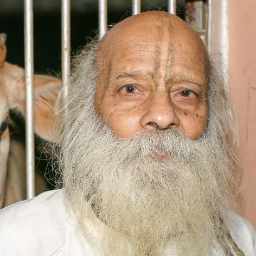
Śrī Haridās Śāstri in Śrī Haribhakti Vilāsa
Śuddha bhakti alone is the supreme object worth attaining; through it alone can every living being dwell in happiness. Only a person who is free of the mentality of being unable to bear another’s excellence, and who is devoted single-mindedly to compassion toward every living being, becomes eligible for this uttamā-bhakti. In the Bhakti-rasāmṛta-sindhu (1.1.11), the defining characteristic of śuddhā-bhakti (another name of uttamā-bhakti) is given as follows – Uttamā-bhakti is the nature of favourably serving Śrī Kṛṣṇa and everything related to Śrī Kṛṣṇa both in one’s thoughts, words and deeds and in one’s feelings, at all times and in all states of consciousness. This nature is without any unfavourableness, is devoid of the tendency of having any desire other than that of serving Śrī Kṛṣṇa and everything related to Śrī Kṛṣṇa. It is also not obscured by knowledge that has liberation as its goal or work that is performed with the expectation of material results or done to avoid them.”
The favourable anuśīlana [explained later], directed either toward the Bhagavān Śrī Kṛṣṇa Himself, Who is full of all opulence and sweetness, Who attracts the entire creation comprising of moving and unmoving beings through His own most wondrous pastimes, the supreme object of love, or toward all things connected with Śrī Kṛṣṇa, is indeed uttamā-bhakti, or in other words, is the defining characteristic of uttamā-bhakti. Whatever way a thing is, that alone constitutes its svarūpa (essential nature).
The characteristic that reveals a thing’s svarūpa – in other words, the mark that conveys the identity of that essential nature – is itself called its svarūpa-lakṣaṇa (essential characteristic) or its mukhya viśeṣaṇa (principal qualifier). The word anuśīlana is derived from the dhātu (verbal root) śīl. Just as the word kriyā (action) conveys, through its form, the meaning of the kṛ dhātu (to do), the word anuśīlana conveys, through its form, just the meaning of the śīl dhātu.
The śīl dhātu means śīlana, which is derived by the addition of the suffix an to the dhātu. It conveys a sense of practice, reflection, observation, and incitement to action. This śīlana is of two kinds, pravṛtti-ātmaka (active in nature) and nivṛtti-ātmaka (refraining in nature). There are the śārīra-ceṣṭā (actions of the body), mānasa-ceṣṭā (actions of the mind) and vāćika-ceṣṭā (actions pertaining to speech) as well as the well-known mānasa bhāva (mental state). Mānasa bhāva, in turn, is prīti-viśadātmaka, having the nature of prīti (affection) and viśada (despair or aversion). The word bhāva means a vṛtti or a state; thus the term mānasa-bhāva refers to the disposition of the mind.